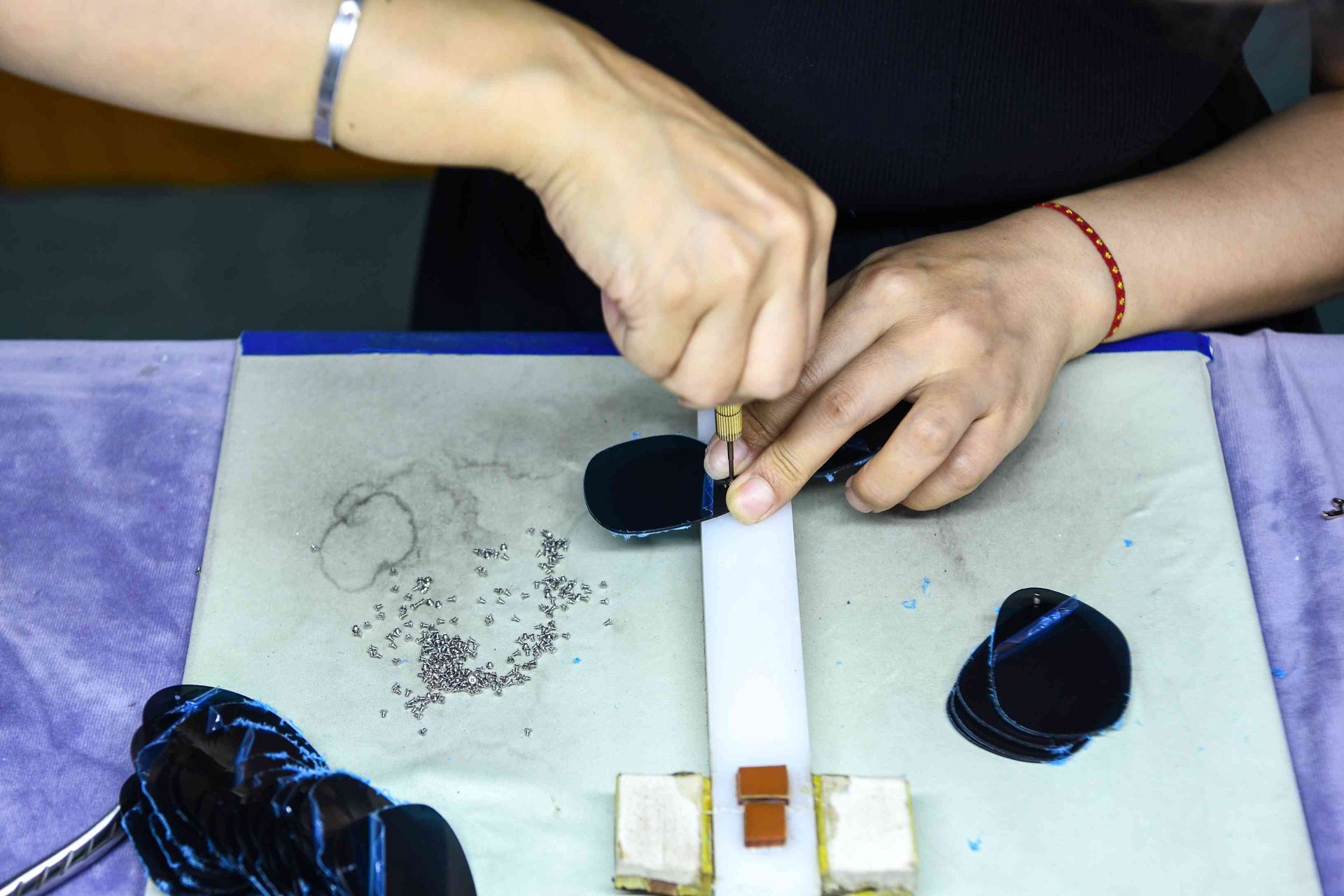
The missing rim is not merely a styling choice. It changes how a lens is processed, retained, assembled, serviced and inspected. A buyer who specifies only “rimless optical frame” leaves unanswered questions about lens material, hole geometry, bushings, screw system and allowable prescription range.
Direct answer: select full-rim, semi-rimless or rimless construction as a complete frame-and-lens system. Confirm the intended lens program first, then define the retention geometry, hardware, assembly method, replacement parts and acceptance criteria. Approve a production-intent glazed sample—not an empty frame—as the master for bulk production.
How the three constructions retain a lens
| Construction | Lens retention | Main advantage | Main control point |
|---|---|---|---|
| Full-rim | The entire beveled lens edge sits in an eyewire or frame groove | Broad material and styling options; protected lens edge | Bevel-to-groove match, seating and frame distortion |
| Semi-rimless | Part eyewire plus a tensioned nylon-type cord in a lens-edge groove | Lightweight visual effect with a defined upper or lower frame line | Groove position, cord specification, tension and service access |
| Rimless | Bridge and endpiece or temple hardware mount directly through or onto processed lenses | Minimal appearance and freedom to vary lens shape | Hole or slot geometry, lens suitability, bushings, alignment and mounting stress |
“Half-rim,” “supra,” “nylor” and “drill-mount” are used differently across markets. Put a section drawing and exploded parts view in the eyewear tech pack rather than relying on a trade name.
Full-rim: forgiving does not mean specification-free
Full-rim acetate, injected and metal frames support many silhouettes and conceal most of the lens edge. The continuous eyewire can protect the edge from direct contact, but the frame, groove and lens bevel still need to match. A lens that is too large or too curved can distort the front; one that is too small may move or show a gap.
The frame material changes the glazing process and service behavior. Heating that is suitable for one polymer may damage another; thin metal eyewires depend on correct closure and screw engagement. Select the material using the eyewear frame material guide, then document the glazing method for the actual model.
Semi-rimless: the groove and cord are structural
In a semi-rimless frame, an exposed portion of the lens edge carries a precisely positioned groove. A cord sits in that groove and is tensioned between anchor points. If the groove is too shallow, deep, high, low or inconsistent, the cord may sit poorly, the lens may shift, or the exposed edge may look uneven. Excessive or uneven tension can also affect the assembly.
Specify the cord material or approved supplier reference, diameter, color, anchor method and replacement procedure. Define groove geometry and location relative to the lens surfaces, plus the finish required on the visible edge. The optical laboratory must confirm that the intended lens material, thickness and prescription range can accept that groove safely.
Rimless: the processed lens becomes part of the frame
A rimless lens is not just an optical insert; it forms the structural link between bridge and temple attachments. Drilled holes, slots or notches must match the selected mounting system. Screws, nuts, compression bushings, sleeves and washers are not interchangeable unless the design owner has validated them as a set.
Critical variables include:
- lens material, minimum local thickness and edge profile;
- hole, slot or notch dimensions, position and distance from the edge;
- drill direction and the lens surface used as the datum;
- bushing, sleeve, washer, screw and nut specification;
- tightening method and validated assembly condition;
- bridge and attachment alignment after mounting;
- permitted lens shapes, sizes and prescription range;
- spare parts and tools supplied to the after-sales network.
Avoid publishing a universal torque or hole distance. The correct limit depends on the lens, hardware and geometry and should come from the validated design and qualified laboratory or component supplier.
Choose by product program, not appearance alone
| Buyer question | Full-rim | Semi-rimless | Rimless |
|---|---|---|---|
| Is a protected lens edge important? | Strongest coverage of the three | Edge remains exposed along part of the lens | Most edge is exposed |
| Will lens shapes change within one chassis? | Usually requires matching eyewire geometry | Limited by eyewire, cord path and anchors | Often offers more shape freedom within validated limits |
| Is local servicing simple? | Familiar to many optical workshops | Cord and grooving knowledge required | Correct hardware, tools and drill-mount experience required |
| Is a minimal visual weight central to the range? | Possible with thin profiles, but rim remains visible | Moderate | Highest |
| Where is process sensitivity concentrated? | Bevel, groove, eyewire closure and frame curve | Lens groove, cord and anchor system | Lens processing, hardware stack and mounting alignment |
This table is a sourcing guide, not a durability ranking. A well-engineered rimless frame can perform reliably, and a poorly glazed full-rim frame can fail. Intended use, lens prescription, design details and verified test results determine suitability.
What to include in the OEM specification
- Define the use and sales market. State optical, sun, reader or other use, expected wearer environment and destination countries.
- Freeze the construction. Add front, side and section views plus an exploded bill of materials for every retaining part.
- Define the lens program. Record lens material, design, thickness rules, base curve, powers or plano scope, coatings and edging data. The lens base curve guide explains why curve and frame geometry must be approved together.
- Control the interface. Specify bevel and eyewire groove for full-rim, cord and lens groove for semi-rimless, or hole and hardware stack for rimless.
- Plan service parts. Identify replacement screws, nuts, bushings, washers and cord, along with compatible tools and instructions.
- Set acceptance criteria. Define cosmetic boundaries, alignment, retention, handling checks and any required laboratory tests without inventing generic limits.
A practical sample approval sequence
Start with a design review between the frame maker, lens processor and optical decision-maker. Produce a complete glazed sample using production-intent lenses, hardware and assembly tools. Inspect lens shape, symmetry, edge finish, alignment, comfort and service access. Where the product will accept prescriptions, validate representative cases within the intended range through the qualified optical laboratory.
Record every change in the custom eyewear sampling process. Once approved, seal the physical sample with its drawing revision, lens data, hardware codes and assembly instructions. An unglazed frame cannot demonstrate cord tension, drill alignment or mounting stress.
Construction-specific pre-shipment checks
For all three systems, confirm the correct lens, orientation, frame geometry, bridge alignment, temple opening and cosmetic finish. Then add the relevant checks:
- Full-rim: continuous seating, even bevel concealment, secure eyewire closure, no unintended gap, lens movement or front distortion.
- Semi-rimless: continuous groove, cord fully seated, consistent tension and anchors, aligned lens edges, no frayed cord or edge damage.
- Rimless: clean holes or slots, correct hardware stack, intact bushings and washers, secure fasteners, symmetric lenses, aligned attachments and no cracks, chips or stress marks.
Add these defect categories to the pre-shipment inspection checklist. Sampling level and acceptance limits should be agreed for the product and risk, not copied blindly from another construction.
Destination-market verification
Frame construction does not determine compliance by itself. Product classification and current requirements can change with the market and use—for example optical frames, sunglasses, readers, children’s products or protective eyewear may follow different optical, mechanical, chemical, labeling and documentation rules.
Before production, have the importer, responsible economic operator, qualified laboratory or compliance adviser confirm the applicable requirements and test plan in each sales market. Use the eyewear certifications guide as orientation, not as market-specific legal advice.
For a useful engineering review, send HAO Eyewear the intended lens program, construction drawing, target market and service plan. Discuss your OEM/ODM eyewear project before the retention system and hardware are locked.