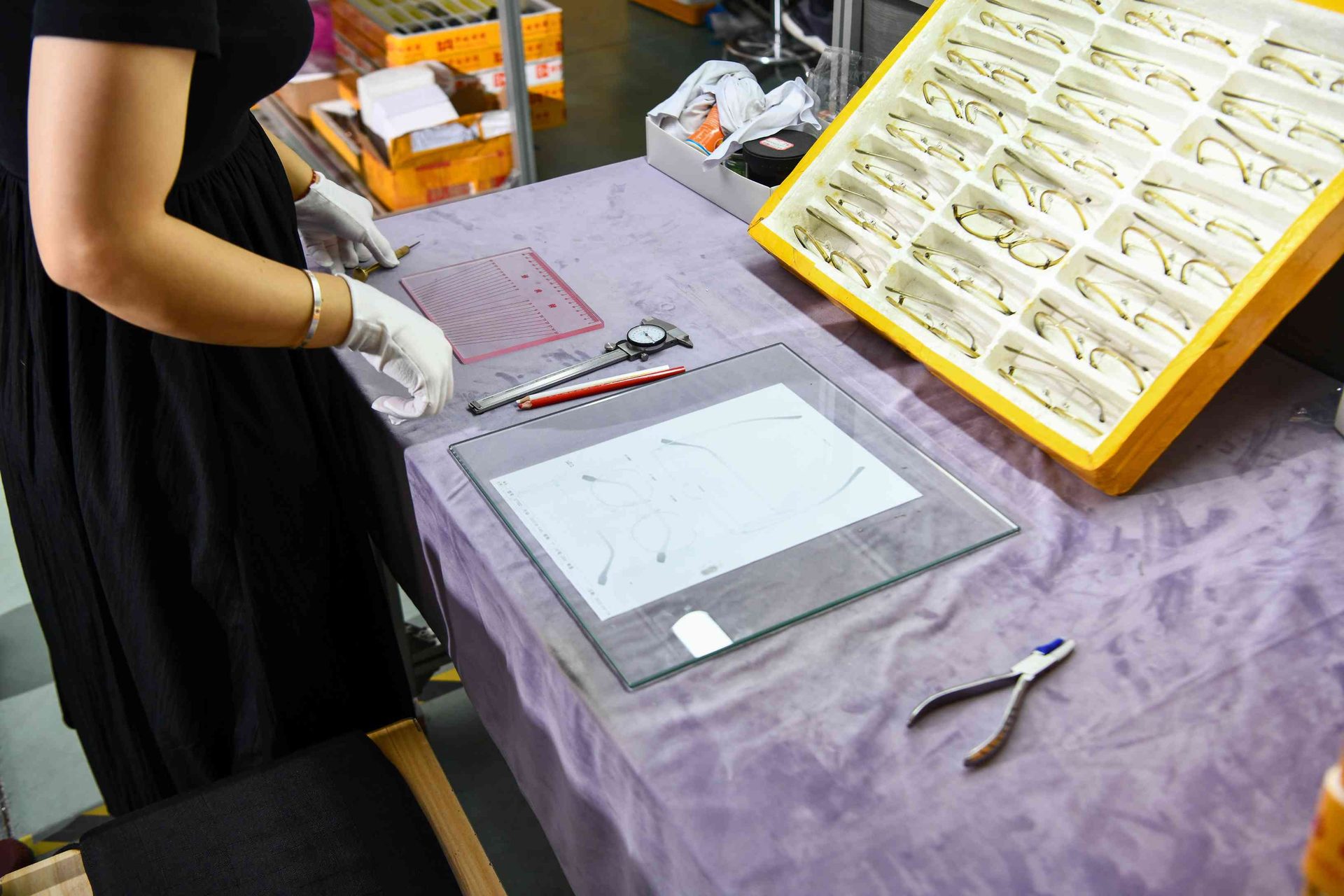
The most expensive eyewear defect is the one you discover after the container arrives. A pre-shipment inspection (PSI) catches problems while the goods are still on the factory floor — when they can still be fixed. This guide explains how eyewear inspection works and gives you a checklist you can use on your next order.
Key takeaways
- A PSI happens when production is ~100% done and ≥80% packed — late enough to judge final quality, early enough to fix.
- Inspect five groups: appearance, dimensions, mechanical function, lenses, packaging/marking.
- Use AQL sampling (commonly 2.5 major / 4.0 minor), not 100% checking.
- Use factory QC + a third-party agency for large or first orders.
- Catching defects pre-shipment is far cheaper than returns, rework or lost customers.
What is a pre-shipment inspection (PSI)?
A pre-shipment inspection is a quality check on a finished order before it ships. An inspector pulls a random sample from the packed goods and checks it against your specifications and an agreed quality standard. The output is a pass/fail report with photos of any defects.
It’s the single most effective quality safeguard in importing — because it happens at the last moment when the factory can still act.
Why inspect eyewear before shipment?
- Defects are cheap to fix in the factory, expensive everywhere else. Rework before shipping costs far less than returns, replacements or refunds.
- Eyewear is detail-sensitive. Scratches, loose hinges, lens distortion and misaligned logos are easy to miss without a structured check.
- It protects your brand. Your customers judge you on the worst frame in the box, not the average.
- It gives leverage. A documented inspection report supports any rework request or claim.
The eyewear quality control checklist
Inspect across these five groups:
| Group | What to check |
|---|---|
| Appearance / cosmetic | No scratches, scuffs or glue marks; smooth polish; consistent color vs the approved sample; even, sharp logo printing; no dust under coatings |
| Dimensions | Frame width, lens width, bridge, temple length vs spec (within tolerance); symmetry left vs right |
| Mechanical function | Smooth hinge action; screws tight and flush; spring hinges work; frame sits flat and aligned; nose pads even |
| Lenses | Clear with no distortion or bubbles; correct tint/mirror/gradient; correct coating (AR, blue light); correct power (readers/RX); UV400 where claimed |
| Packaging / marking | Correct case, pouch, cloth, box; correct labels, barcodes, hang tags; carton markings, quantities and gross/net weights correct |
Bring your approved golden sample to the inspection — it’s the reference for “correct.”
AQL sampling: how many pairs to inspect?
You don’t check every piece — you check a statistically valid random sample using AQL (Acceptable Quality Limit), defined by ISO 2859-1 / ANSI Z1.4. Defects are graded:
| Defect class | Example | Common AQL |
|---|---|---|
| Critical | Safety issue (e.g. sharp edge, no UV when claimed) | 0 (none allowed) |
| Major | Defect a customer would reject (deep scratch, broken hinge) | 2.5 |
| Minor | Small flaw unlikely to cause rejection | 4.0 |
The batch size sets the sample size (most buyers use General Inspection Level II). The AQL then sets how many defects are allowed before the lot fails. Agree these numbers with your supplier before production so “pass” means the same thing to both sides.
Who does the inspection?
- Factory QC (baseline): A good factory inspects every piece in-house through multi-stage QC. Always expect this — see how we approach it on our quality page.
- Your own staff/agent: If you have someone in China, they can inspect on your behalf.
- Third-party agency: Independent firms (SGS, Bureau Veritas, QIMA, etc.) give an unbiased report — worth it for large or first orders.
A strong factory QC plus a third-party check on key orders is the most common setup.
Common eyewear defects to watch for
- Scratches, scuffs or polishing marks on frames or lenses
- Loose or stiff hinges; protruding or missing screws
- Frame asymmetry or temples that don’t fold flat
- Lens distortion, bubbles, or wrong tint/coating
- Color mismatch vs the approved sample
- Misaligned or smudged logo printing
- Wrong or missing labels, barcodes or packaging
- Incorrect carton quantities or markings
When to inspect (timeline)
Schedule the PSI when production is ~100% complete and at least 80% packed. Too early and you can’t judge final quality or packaging; too late and there’s no time to rework before the ship date. Build a few buffer days into your timeline for possible rework — see our importing eyewear from China guide for how inspection fits the wider shipping schedule.
Quality you can verify
We run multi-stage in-house QC on every order and welcome third-party inspections. If you’re planning your first order, our guide on how to start an eyewear brand walks through samples, MOQs and timelines. Ready to discuss specs and quality standards? Contact our team — we reply within 24 hours.