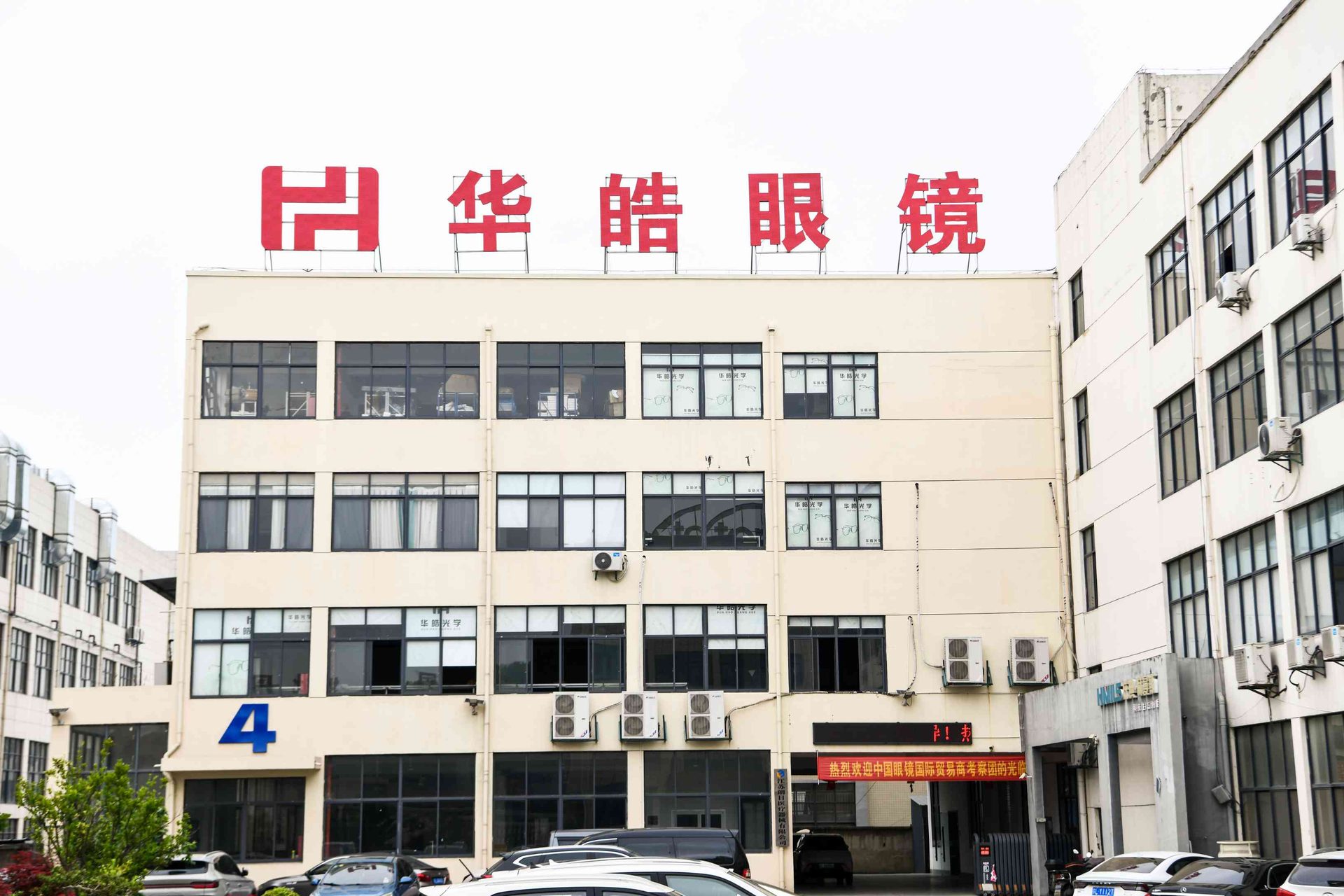
If you are searching for a Danyang eyewear manufacturer, the city’s biggest advantage is not a single low price. It is the concentration of an entire optical supply chain in one place.
Official and state-media reports describe more than 1,600 eyewear and supporting businesses, over 50,000 workers, and annual output above 400 million pairs of spectacle lenses. Reported lens share is about 70% of China and roughly half of global production. Those figures explain why Danyang can move quickly—but they do not remove the need to qualify the factory that will make your order.
Buyer answer in 30 seconds: shortlist Danyang when your project needs lenses, prescription-ready frames, multiple materials or fast component coordination. Select the supplier by verified process capability, not by city name or the lowest quotation.
Danyang eyewear industry: the numbers behind the claim
| Reported indicator | Latest useful figure | What it means for buyers |
|---|---|---|
| Eyewear and supporting enterprises | 1,600+ | Broad supplier and service base |
| Manufacturing enterprises | 600+ | Many production options, but different specialties |
| Trade and supporting-service businesses | 1,000+ | Dense sourcing, packaging, logistics and channel network |
| Industry employment | 50,000+ | Large pool of optical and production experience |
| Annual spectacle-lens output | 400 million+ pairs | Exceptional lens capacity and process specialization |
| Share of Chinese lens output | About 70% | National-scale purchasing and production ecosystem |
| Share of global lens output | About 50% | Global relevance, not just a domestic wholesale market |
| 2025 export value | RMB 5.162 billion | Established export flow and documentation experience |
| Export markets | 150+ countries and regions | Products already serve diverse market requirements |
The cluster figures come from recent reports by the Danyang Optical Chamber of Commerce, China’s State Taxation Administration and People’s Daily. Percentages can differ slightly by year and whether a source counts pairs, pieces or a narrower lens category; this guide therefore uses rounded figures and identifies them as reported estimates.
What the $8-glasses video gets right—and what buyers must verify
The video that prompted this analysis, “China’s $8 glasses break the US eyewear monopoly”, makes a useful distinction: the manufacturing cost of eyewear is not the same as its retail price. Brand licensing, store rent, sales commissions, marketing, distribution, insurance administration and after-sales service can all sit above factory cost.
Its stronger lesson is about supply-chain economics. Danyang can reduce cost through volume, short supplier distances, specialized labor, shared infrastructure and intense competition. A frame maker can coordinate nearby lens, hinge, plating, printing, packaging and testing resources without rebuilding every capability from zero.
But “low factory cost” is not proof of “identical quality.” Two visually similar products may differ in:
- exact resin, acetate, TR90 or metal grade;
- lens material, optical design, power tolerance and centration;
- coating stack, adhesion and durability;
- hinge, screw and plating specification;
- polishing, color consistency and assembly tolerance;
- test plan, inspection level and traceability;
- packaging, warranty and regulatory documentation.
A credible manufacturer should explain why its quotation is efficient and what is included—not simply claim that all expensive eyewear is marketing.
Seven advantages of sourcing from Danyang
1. A complete local optical chain
The 2026 chamber report describes a chain covering raw materials, molds, lenses, frames, intelligent equipment, testing, market trading, e-commerce and logistics. For an OEM/ODM buyer, proximity reduces handoffs and helps resolve component mismatches before they become finished-goods failures.
2. Lens capacity few clusters can match
Danyang’s defining strength is spectacle lenses. Buyers can access common resin lenses, higher-index options, photochromic and functional products, coatings and prescription processing through a mature ecosystem. A frame program that will later be fitted with lenses benefits from early coordination of groove, bevel, base curve, eye size and mounting method.
For the technical history of the cluster, see how Danyang reinvented lens manufacturing.
3. Lower coordination cost—not magic pricing
Nearby suppliers reduce transport, waiting and minimum-order friction between processes. Repeated programs can reuse approved colors, components and tooling. That can lower total development cost, especially when a collection contains several SKUs.
The correct comparison is landed, specification-matched cost: tooling, samples, testing, packaging, rejects, freight, duty and rework—not a bare ex-factory number.
4. Faster sampling and problem solving
When a hinge interferes with a temple core or a lens bevel does not fit the rim, engineering changes can move between nearby specialists faster. Speed still depends on a complete eyewear tech pack and controlled sample approval; proximity cannot compensate for an unclear specification.
5. Broad process and material access
The cluster supports acetate, injected polymers such as TR90, metal and titanium constructions, plus associated hinges, nose pads, finishes and packaging. Not every supplier makes every material. A buyer should select the factory whose normal production route matches the design rather than asking a specialist to learn a new process on the order.
6. Testing and quality infrastructure
Danyang hosts national-level optical product testing infrastructure and participates in standards work. The chamber reports that 76 businesses hold ISO quality-system certification. Certification can support a system, but it does not approve your SKU. Your purchase specification must still define relevant tests, sampling and pass/fail limits for the destination market.
7. Export depth
The chamber reports 2025 eyewear exports of RMB 5.162 billion, up 4.8%, with products reaching more than 150 countries and regions. This does not mean every workshop is export-ready. It does mean the city contains experienced export teams, forwarders, laboratories and packaging resources that can support international programs.
What Danyang does not guarantee
The city name is not a quality mark. A large cluster includes vertically integrated factories, assembly plants, process specialists, trading companies and small workshops. Each can be legitimate, but they solve different problems.
Watch for four sourcing mistakes:
- Assuming “manufacturer” means every process is in-house. Ask for a process map that names subcontracted steps.
- Comparing quotations with different assumptions. One quote may exclude lenses, tests, packaging or tooling.
- Approving appearance without approving performance. Color and logo are not substitutes for dimensional, mechanical and optical requirements.
- Using a cluster statistic as supplier evidence. Danyang’s output proves ecosystem scale, not the capacity or compliance of one factory.
Which type of Danyang supplier fits your project?
| Supplier model | Best suited to | Question to ask first |
|---|---|---|
| Integrated frame factory | Custom frame collections and repeat programs | Which processes and materials run in-house? |
| Lens specialist | Prescription, functional or coating programs | Which designs, indices and tests are routinely controlled? |
| Process specialist | Plating, painting, printing, CNC or components | How is traceability maintained to the finished SKU? |
| Trading or sourcing company | Multi-category buying and lower coordination workload | Which factories make each item, and who owns QC responsibility? |
| Ready-stock supplier | Fast market tests and small initial ranges | What can be customized without changing the stock platform? |
There is no universally best model. A transparent trading partner can be safer than a factory taking work outside its competence; an integrated manufacturer is valuable when its real capability matches your product.
Danyang vs Shenzhen, Wenzhou and Xiamen
| Cluster | Typical strength | Consider it when |
|---|---|---|
| Danyang, Jiangsu | Lenses, broad optical chain, frames and component coordination | You want lens-frame integration or a deep multi-process ecosystem |
| Shenzhen, Guangdong | International business, product development, electronics and premium export programs | Communication, smart hardware or complex development is central |
| Wenzhou, Zhejiang | Large frame base, especially metal and volume production | Your program aligns with established frame processes and scale |
| Xiamen, Fujian | Sunglasses and export-oriented production | Sunwear is the main category |
These are cluster tendencies, not rankings. Audit the actual supplier rather than choosing by postcode.
A 12-point factory verification checklist
Before issuing a production order, verify:
- Chinese legal company name, registration number and business scope.
- Production address and its relationship to the contracting entity.
- In-house and subcontracted process map.
- Equipment list, normal materials and real monthly capacity.
- Incoming, in-process and final QC checkpoints.
- Measuring equipment and current calibration records.
- Comparable product samples and production references.
- Destination-market testing and documentation responsibilities.
- Signed golden sample, drawings, BOM and color standards.
- AQL or other sampling plan with defect classifications.
- Tooling ownership, storage, maintenance and change control.
- Pre-shipment inspection, nonconformance and remake terms.
Use the pre-shipment inspection checklist to turn these points into an executable control plan.
What to include in your RFQ
An answerable request for quotation should contain:
- product category and intended user;
- destination countries and sales channel;
- drawings, dimensions, tolerances and reference samples;
- frame and lens material grades;
- color, finish, hardware and logo method;
- optical or mechanical performance requirements;
- packaging, labeling and barcode needs;
- test standards and required reports;
- quantity by SKU and forecast assumptions;
- sample, production and shipment dates.
Ask the supplier to return a list of assumptions, exclusions and subcontracted operations with the quote. That single step makes price comparisons far more meaningful.
How HAO Eyewear uses the Danyang ecosystem
HAO Eyewear combines a 5,000 m² production base in Danyang with an international business office in Shenzhen. The Danyang operation handles core frame processes including injection, welding, finishing, painting and assembly, while the surrounding cluster provides access to specialized optical and component resources. Shenzhen supports international communication, development coordination and export service.
That combination is useful only if it matches your specification. Send a drawing, target market, material, quantity and schedule through our OEM/ODM project form, and we will identify the feasible production route, required samples and open assumptions before quotation.
Sources and methodology
- Danyang Optical Chamber of Commerce: 2025 industry data and complete supply chain
- State Taxation Administration: Danyang eyewear cluster, employment and lens output
- People’s Daily: Danyang’s 1,600-company cluster and 400-million-pair lens output
- EssilorLuxottica 2024 Universal Registration Document: Danyang manufacturing presence
- Video reviewed: China’s $8 glasses and the eyewear price chain
Industry totals are attributed to their publishers and rounded. Factory-selection recommendations are HAO Eyewear’s sourcing guidance; they should not be read as a certification of every business in Danyang.