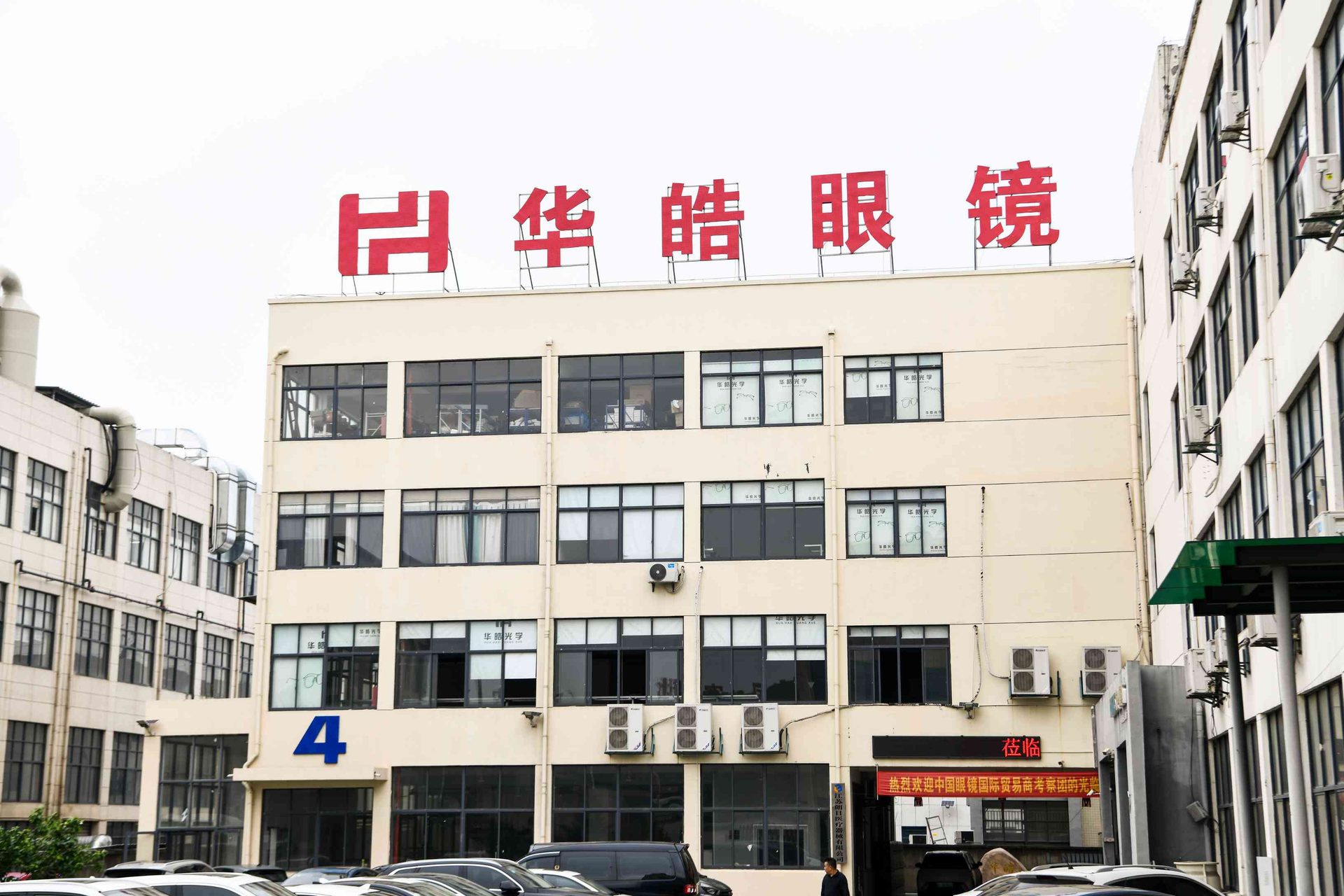
You probably don’t know Danyang. You have almost certainly worn its lenses.
This county-level city in Jiangsu province turns out an estimated half of the world’s eyewear lenses and around 70% of China’s — hundreds of millions of pairs a year, from roughly 1,600 companies employing close to 50,000 people. A multi-billion-dollar global champion industry, grown inside a single county town. And recently it did something that sounds, at first, slightly absurd: it started machining lenses with the same kind of lithography used to make computer chips.
This is the story of how a town that began by hand-grinding glass became the quiet center of the world’s optics supply chain — and why that matters if you buy or build eyewear.
Key takeaways
- Danyang makes ~50% of the world’s lenses and ~70% of China’s — a true global-champion cluster in one county.
- Its edge is compounding, not luck — glass → resin → high-index → functional → lithography, each step built on the last.
- Lithography changes the rules — etching nanostructures (not grinding curves) can cut a 1500-degree lens to ~2 mm with ~95% material utilization.
- Smart glasses run through Danyang — the lens can be ~1/4 of an AI-glasses BOM, making the cluster hard to bypass.
How a county town came to make half the world’s lenses
The story starts in the 1960s. In Situ, a town under Danyang, a group of young people traveled to state-run optical factories in Shanghai and Suzhou to apprentice as glass-lens grinders. They brought the craft home, pooled a few rooms and a dozen hands, and started workshops. Equipment was crude and quality control was literally eyesight; grinding a single lens took hours, and polishing powder stained skin red. Old-timers still describe those grinders as “red-faced” workers.
When reform-era markets opened in the early 1980s, lens workshops spread across Situ, and the local government built the Huayang eyewear market — one of China’s first specialized eyewear marketplaces. It reportedly cleared more than a million yuan in turnover within two months of opening. The Danyang name was on the map.
Industrial clustering, once it starts, is hard to stop. Lens makers drew frame makers, who drew coating shops, packaging suppliers and logistics firms. Within a radius of a few dozen kilometers, every part and process needed to turn raw material into a finished pair of glasses could be sourced locally. Where other regions build supply chains with investment fairs and industrial parks, Danyang assembled its upstream and downstream on the back of an electric scooter.
 Danyang’s cluster keeps a full eyewear supply chain — materials, frames, lenses, coatings, packaging — within roughly a 30 km radius.
Then came a crisis. After China joined the WTO, lightweight, shatter-resistant resin lenses poured in from abroad and undercut the glass lenses Danyang depended on. Small factories closed; the industry faced obsolescence. The turning point came in 1996, when a leading Danyang firm pushed resin into production locally — a brutal process, since resin is acutely temperature-sensitive and the team scrapped countless lenses over roughly three years before getting it right. But once that step was taken, Danyang pulled decisively ahead of every rival region.
By 2025, local figures put the cluster at over 1,600 eyewear and supporting companies, nearly 50,000 workers, and billions of yuan in sales and exports. A county-level city built a global-champion industry not on some dropped-from-the-sky breakthrough, but on the plainest clustering logic: the first cohort did it, relatives and friends followed, skills circulated locally, the supply chain took root, and costs thinned out across the cluster.
From resin to high-index: decades of incremental gains
After resin, Danyang didn’t sit back and count money. Over the next two decades the cluster kept climbing. Local firms developed lens materials at a 1.71 refractive index — the higher the index, the thinner a lens can be at the same prescription — a number previously dominated by foreign suppliers. As myopia control became a society-wide concern, defocus lenses appeared: corrective in the center, with a special peripheral optical design intended to slow the progression of nearsightedness. Photochromic lenses arrived too, clear indoors and darkening in sunlight. AI inspection moved onto production lines, and custom-lens turnaround compressed from weeks to days.
No single step was big news. Stacked together, Danyang’s lenses moved from merely wearable to genuinely good to wear. But traditional processes have a ceiling. However you optimize injection or lathe-cutting, you are still carving a curved surface, with precision around ±5 microns — and for very strong prescriptions, thickness simply hits a wall. A real breakthrough needed a different road.
The lithography leap: making lenses like microchips
In late 2024, a company registered in Danyang that brought neither a new lens material nor a faster molding line, but a full set of semiconductor lithography equipment. Yellow-light cleanrooms, photoresist, nanoscale etching — the stuff of chip-factory news — moved into a lens plant.
Here is why that matters. Traditional lenses, whether molded or lathe-cut, bend light by shaping a curved surface; the steeper the curve, the thicker the lens. High prescriptions can leave a center five or six millimeters thick — bottle-bottoms on your face — with most of the material ground away as waste. The physics is unforgiving: as long as you bend light by curving material, thickness won’t fall far.
Lithography is a different idea entirely. Instead of carving a curve, it etches a dense field of nanoscale pillars onto a near-flat surface — each pillar a tiny fraction of a hair’s width. Light passing through is slowed by different amounts depending on pillar height and width; arrange the pillars precisely and you steer the wavefront, achieving the same effect as a curved surface without thickening the material. Per reporting in Xinhua Daily, the Danyang process etches a honeycomb nanostructure at 0.1-micron precision — about 50× finer than conventional methods — cutting a 1500-degree lens to roughly 2 mm, about a third of a traditional lens, while lifting material utilization from under 30% to around 95%.
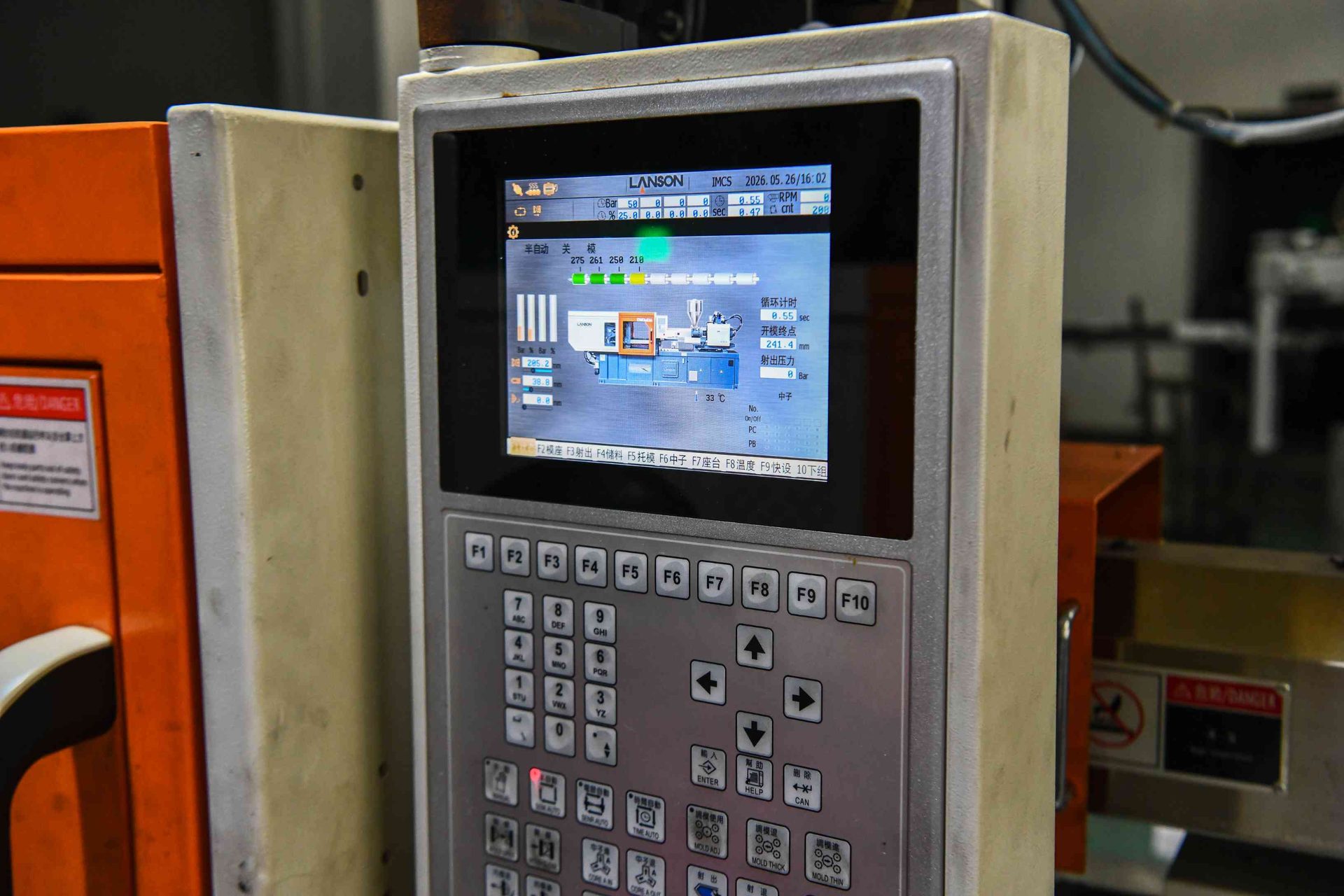 Precision machining and AI-driven systems have reshaped how lenses and frames are made in Danyang’s newer workshops.
It isn’t only hardware. The same effort paired the process with an AI-driven customization system. Traditionally a patient is refracted, a doctor writes a single prescription power, and the factory makes to that number — the clinician can adjust very little. The new system reportedly expands the adjustable parameters from one to nine, including how power is distributed and graded across different zones of the lens — pulling the clinician into the front end of lens design rather than just prescribing a number at the back end.
The pace of all this was almost unreasonable: trial production in April 2025, mass production by July, 200,000 lenses sold in half a year, and a stated ambition to scale output sharply the following year. In another city this would be a startup miracle; in Danyang it’s normal speed. Bring anything lens-adjacent here and the supply chain, talent pool, channels and market feedback let you run the full loop at the lowest possible cost of trial and error.
Metalenses and the bigger picture
Pull the lens back further. In academia, controlling light with nanostructures has a more formal name: the metalens, or metasurface optics. A conventional lens bends light by making it pass through varying thicknesses of curved glass — which is why the camera bump on the back of your phone, a stack of curved elements, always protrudes. A metalens stands thousands of nanoscale pillars on a film thinner than paper; light through different pillars is slowed differently, focusing and steering it exactly like curved glass, but in a film-thin form. If it matures, that camera bump could one day disappear.
Metalenses made the cover of Science in 2016, but carried one stubborn problem: easy in the lab, impossible at volume. Classic fabrication relied on electron-beam lithography, which writes one tiny patch at a time — fine for a few samples, hopeless for millions. In June 2026, teams from Sungkyunkwan University and POSTECH in South Korea published a solution in Nature: a roll-to-roll nanoimprint system that, in essence, lithographs a master mold on a 12-inch wafer (450 metalens units), uses it as a stamp to UV-imprint the nanostructure onto flexible PET film, then runs that film through a newspaper-style roll press — 275 mm wide, 200 m long, every imprint taking about 1.5 seconds, lifting throughput by two orders of magnitude. From lab concept to “printed like newspaper” took a full decade.
Strictly speaking, what Danyang’s firms do today isn’t the academic metalens — it uses semiconductor lithography to machine micro/nano structures onto lenses through precision processing. But the direction is the same: use surface microstructure to control light, instead of bending material. Danyang’s lithography lenses can be read as an early, commercial landing of that bigger trajectory in consumer optics.
Why smart glasses run through Danyang
Over the past two years, smart glasses jumped from a fringe category to one of consumer electronics’ hottest races. Whoever builds them, they all hit the same core component: the lens. And the lens carries more weight than many assume — according to data cited by the Zhenjiang industry authority, lenses account for nearly a quarter of an AI-glasses bill of materials. A pair of smart glasses has to pack in a battery, chip, microphone and speaker without turning heavy or ugly, which only raises the bar for thin, high-performance lenses. You can switch chip suppliers and outsource software; you cannot skip the lens.
A quarter of the BOM means Danyang isn’t riding the smart-glasses trend — it’s an unavoidable link in the chain. Local firms have already moved: one became the exclusive recommended optical-lens brand for a major smartphone maker’s AI glasses; another leading company signed an AI-glasses strategic partnership with a national AI champion. Others have launched smart glasses with integrated audio, AI object recognition and live translation, or are building high-end AR lines. Even finished-device makers are setting up production in Danyang.
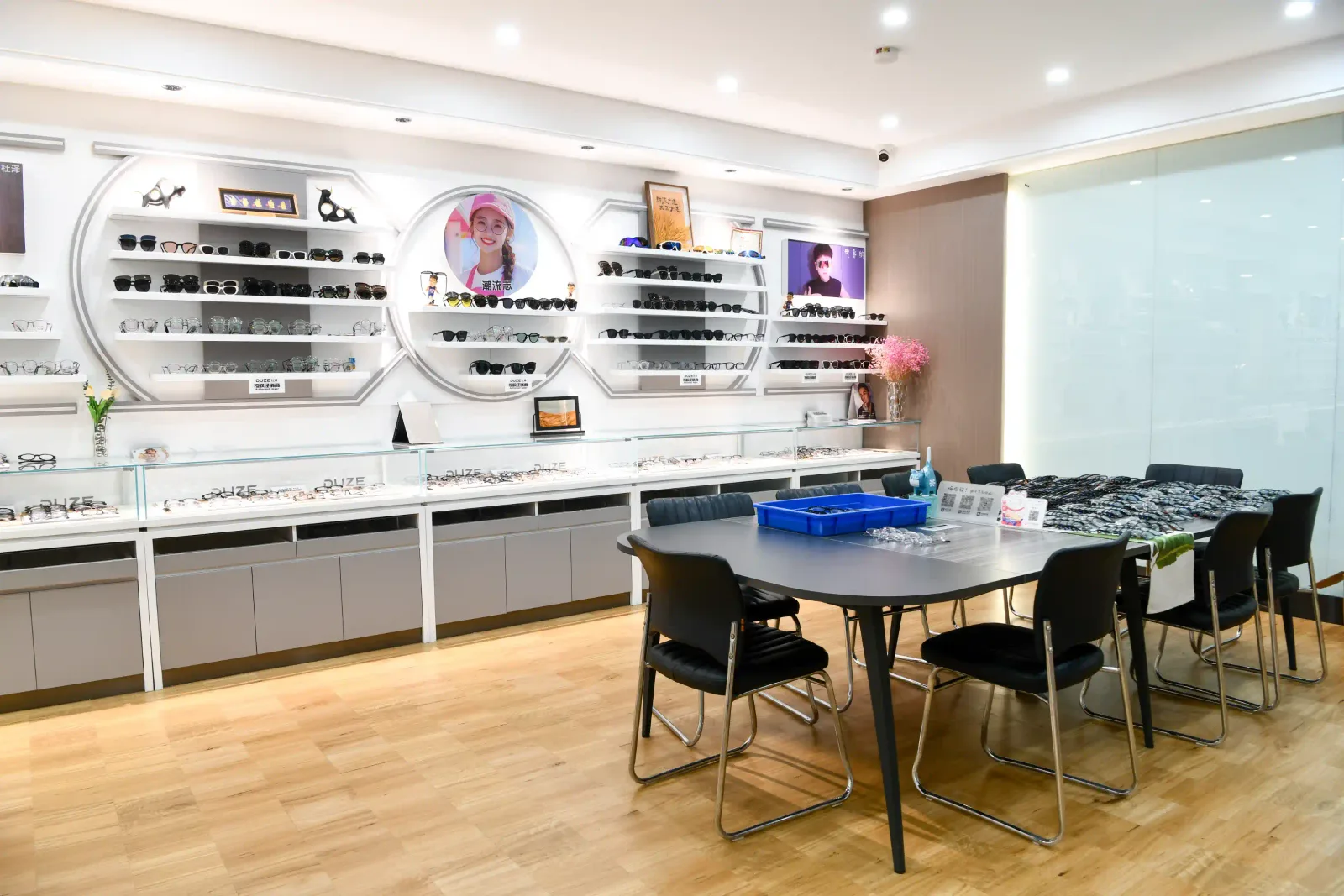 The same cluster that perfected lenses now anchors a fast-moving frame and smart-eyewear ecosystem.
Policy is following. Danyang has formed a dedicated working group for AI-enabled visual optics, and is building eyewear e-commerce parks, innovation centers and a smart-glasses showcase. A county-level city competing with first-tier innovation hubs for position in smart wearables sounds improbable — but Danyang’s hand is genuinely strong: the world’s densest lens supply chain, decades of accumulated optical-processing know-how, and supporting industry that can respond to new demand fast. First-tier cities have internet giants; Danyang has 1,600 factories that can turn a lens or a frame from drawing into object, within a 30 km radius.
What this means for eyewear buyers
For brands and distributors, Danyang’s depth is the real product. The same clustering that lets a lithography startup reach mass production in months is what lets a frame buyer move quickly: short lead times, broad access to materials and finishes, and a low cost of trial and error when iterating on custom designs. You don’t have to be in the metalens business to benefit — you benefit from sourcing inside an ecosystem that has been compounding optical expertise for sixty years.
Sixty years ago, young people came back from Shanghai to grind glass in Situ workshops, polishing powder caking their faces. Today, in the same county, technicians watch over lithography tools. The name is still “eyewear” — but the distance from a textbook sketch of a convex lens to a nanoscale honeycomb in a yellow-light cleanroom is exactly the industrial depth one county ground out over six decades.
HAO Eyewear’s own production base sits inside this Danyang ecosystem. If you’re sourcing OEM/ODM frames and want a partner with the cluster behind it, tell us about your project or browse our ready-stock catalogs — and see our guide to why Danyang became the eyewear capital for more background.