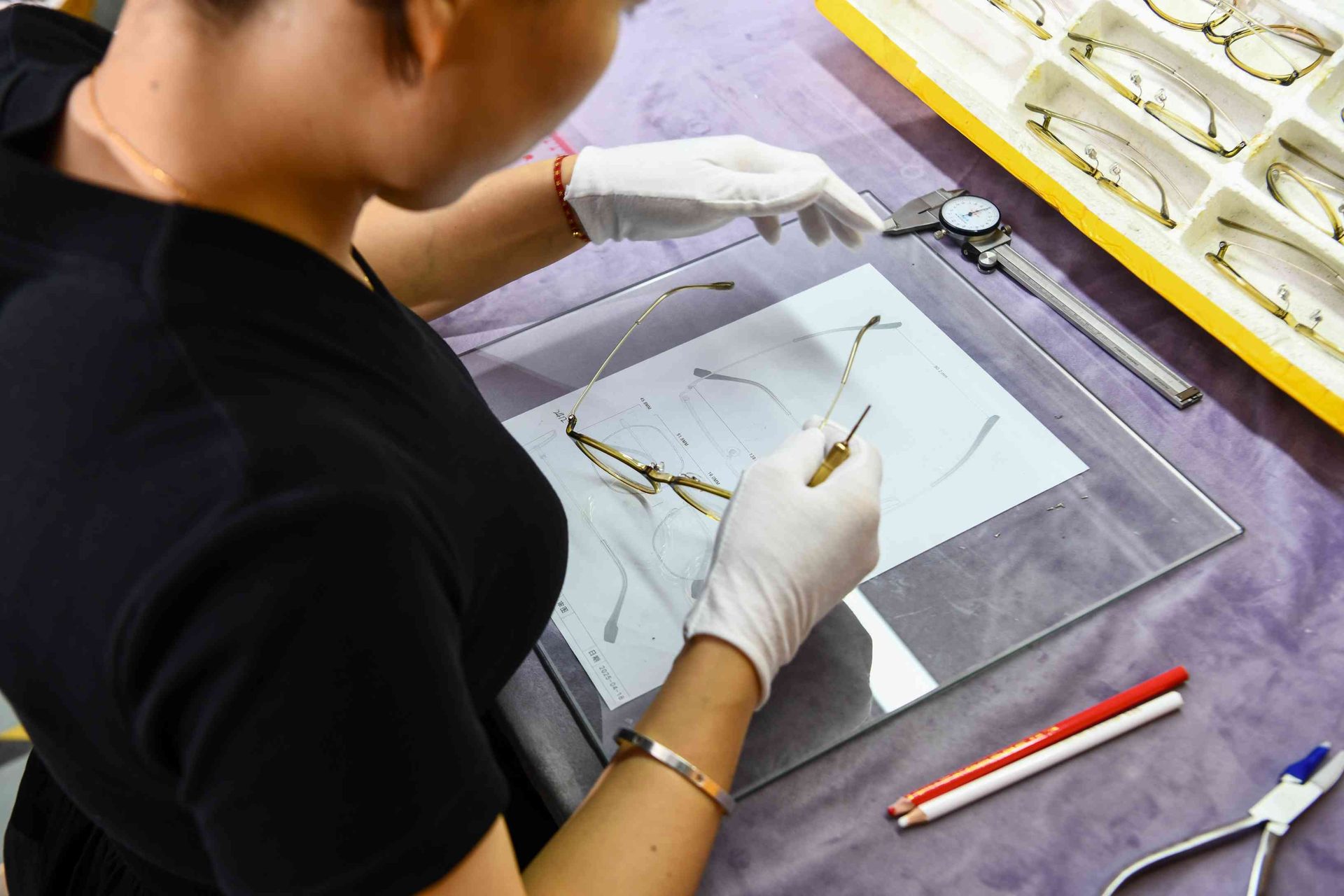
The bridge connects the two lens areas and supports much of the frame at the nose. A size mark may reduce it to one number, but bridge fit is produced by a three-dimensional combination of opening shape, contact surfaces, height, angle, material, front curve, frame weight and temple geometry.
Direct answer: specify an eyewear bridge as a complete fit interface. Record the DBL measurement and its datum, construction type, inner contact geometry, crest position, front thickness and curve, pad system where used, target wearer range and acceptance method. Approve it on a production-intent frame with the intended lenses and temples; the printed bridge number alone cannot predict fit.
Separate DBL from the geometry that touches the nose
In the boxing system, DBL is the minimum horizontal distance between the rectangular boxes that enclose the right and left lens shapes. It is useful for frame and lens layout, but it is not a direct measurement of the wearer’s nose or of the entire bridge opening.
Start with the eyewear size guide, then add section views and datums for the actual contact surfaces. State whether a dimension is taken on the drawing, on the finished frame or after glazing. Polishing, coating, molding shrinkage and lens insertion can change a finished bridge even when the nominal size code remains unchanged.
Compare bridge constructions by fit mechanism
| Construction | How it supports the frame | Main specification risk |
|---|---|---|
| Saddle or continuous fixed bridge | Distributes contact over a broader inner surface | A small geometry error cannot be adjusted locally |
| Keyhole-style fixed bridge | Uses a shaped upper opening and side contact zones | The style name does not define the real contact points |
| Adjustable pad bridge | Supports the frame through two pads and pad arms | Position, angle, symmetry and retention add variables |
| Double-bridge front | Adds an upper bar to the front architecture | The upper bar may be decorative or structural; it does not define nose fit |
Choose the construction from wearer needs, frame material, weight, desired adjustment and service plan. The nose-pad guide explains pad mounts and materials; the bridge drawing must still locate those pads relative to the lenses and frame front.
Define the three-dimensional fit interface
A production drawing should show the bridge from the front, top and a relevant section. Define:
- DBL and lens-shape reference, plus the measurement method.
- Inner width at agreed heights, opening profile, radii and contact zones.
- Crest height and the intended vertical position of the frame.
- Front thickness, face-form curve and bridge projection.
- For fixed bridges, the final polished or molded inner surface.
- For pad systems, arm position, pad center, angle, size, mount and adjustment range.
- Cosmetic boundaries, edge radii and critical-to-quality tolerances.
Do not replace these controls with labels such as “Asian fit,” “low-bridge fit” or “universal fit.” If such a commercial fit name is used, connect it to a controlled geometry, target wearer panel and approved sample.
Evaluate the bridge with the complete frame
Bridge fit interacts with lens weight, front width, frame curve, endpieces and temples. A front that sits correctly as an empty sample may slide, rotate or move too close to the eyes after the intended lenses are fitted. Changing temple spread to compensate can create side pressure without fixing the bridge.
Use the eyewear temple design guide to control the other half of the fit system. On the defined wearer range or suitable fit fixtures, check frame height, level, stability during normal head movement, contact distribution, eyelash and cheek clearance, field of view and any local pressure. Record the method instead of relying on “fits well.”
Approve samples in six controlled steps
- Confirm material, process route, lens shape and all bridge datums against the released drawing.
- Inspect the unfinished or early engineering sample where polishing, molding or joining can still be corrected.
- Assemble production-intent pads, hardware, temples and lenses.
- Measure symmetry, DBL, contact geometry, frame position and relevant clearances.
- Conduct the agreed fit review, adjustment and construction-appropriate conditioning checks.
- Re-measure, document the approved sample and release measurable limits for production.
Add these gates to the custom eyewear sampling process. A copied sample is not enough: wear, manual adjustment or an unknown lens configuration may hide the original design intent.
Control bridge variation in bulk production
For acetate, monitor material thickness, machining, tumbling and polishing because the final inner surface can be rounded or thinned. For injected fronts, track cavity, resin and molding changes that can shift or warp the bridge. For metal frames, control forming and joining fixtures, pad-arm position, heat distortion and coating buildup.
Final inspection should cover agreed dimensions, symmetry, surface smoothness, exposed substrate, pad condition, sharp edges, frame level, lens seating and fit-related clearances. Trace any change to material, tool, cavity, polishing fixture, joining fixture, pad system, coating or lens configuration through formal change control rather than silent substitution.
Send suppliers a bridge brief they can verify
Include 2D/3D data, lens shape and configuration, material and process, bridge construction, DBL and section dimensions, target wearer range, frame weight, temples, pad system, fit-review method, tolerances, destination markets, sample stages and required records. Ask the supplier to identify assumptions and dimensions that their process cannot hold without revision.
Wearer-contact material restrictions, mechanical and optical requirements, labeling and rules for children’s, sunglass, protective or prescription products vary by product class and destination. Before production, have the responsible importer, qualified laboratory or compliance adviser verify current market requirements and the evidence plan for the complete product.
Discuss a production-ready eyewear bridge specification with HAO Eyewear.