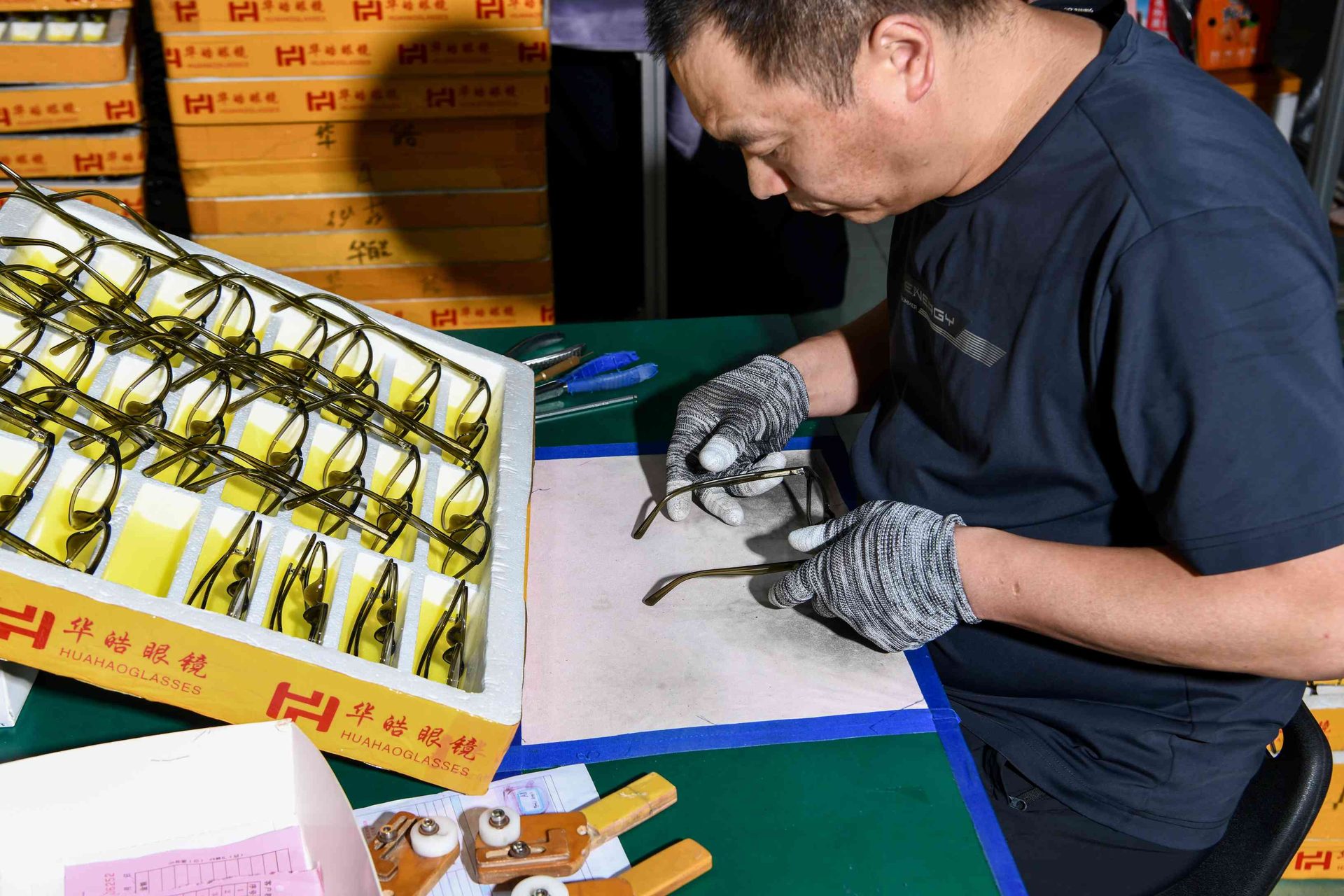
“Can you do OEM?” is one of the first questions buyers ask an eyewear factory. But OEM, ODM and private label are three different manufacturing models — and choosing the wrong one can cost you months of lead time or thousands of dollars in unnecessary tooling.
This guide explains exactly what each model means, what it costs, and how to decide which fits your brand.
Key takeaways
- OEM = your design, your brand. Maximum control and exclusivity; highest upfront cost; MOQ ~500 pcs/style.
- ODM = the factory’s design, your brand. Faster and cheaper; MOQ often 100–300 pcs/style.
- Private label = a form of ODM; an existing frame sold under your logo, from as few as 5 pcs on ready stock.
- Choose OEM for a unique product and long-term moat; ODM/private label for speed, low cost and market testing.
- Most successful brands combine models — start on ODM/stock, then move bestsellers to OEM.
What do OEM, ODM and private label actually mean?
These three terms are used loosely across the industry, but they describe genuinely different relationships with the factory.
| Model | Who owns the design | What you provide | What the factory provides |
|---|---|---|---|
| OEM | You | Design, drawings or a tech pack | Manufacturing, tooling, your branding |
| ODM | The factory | Brand, logo, color/spec choices | Existing design + manufacturing |
| Private label | The factory | Just your logo and packaging | A finished, proven product |
The simplest way to remember it: OEM is “build to my design,” ODM is “design it for me,” and private label is “put my name on yours.”
OEM eyewear: full custom manufacturing
With OEM (Original Equipment Manufacturing), you bring the design — a sketch, a CAD file, a reference frame, or a complete tech pack — and the factory turns it into a production-ready product carrying your brand.
Best for: brands with a distinct design identity, established players seeking exclusivity, and anyone building a long-term product moat.
Pros
- Full design control and a product no competitor can copy off the shelf.
- Your own molds and tooling — better unit economics at scale.
- Complete say over materials, hinges, finishes and packaging.
Cons
- Highest upfront investment (design + tooling + sampling).
- Longer timeline: design and tooling add weeks before production.
- Higher MOQ — typically around 500 pieces per style.
The OEM process runs through design, sampling (7–14 days), tooling, mass production (25–35 days) and QC. See our optical frames OEM/ODM services for the full step-by-step.
ODM eyewear: faster, lower-cost branded designs
With ODM (Original Design Manufacturing), you choose from the factory’s existing, in-house designs and sell them under your own brand. You can still customize colors, finishes, lens options and logo placement — you just start from a proven base instead of a blank sheet.
Best for: brands that want speed, lower upfront cost, and reduced design risk.
Pros
- No design or tooling cost — the molds already exist.
- Lower MOQ, often 100–300 pieces per style.
- Faster to market; proven designs reduce sampling risk.
Cons
- Less exclusivity — other buyers can license similar designs.
- Less control over core structure (you customize, not invent).
Because we release 60–80 new in-house designs every month, ODM buyers always have a fresh, on-trend catalog to brand as their own.
Private label eyewear: rebranding proven products
Private label is the lightest-touch model: you take an existing, finished frame and sell it under your name and logo, with no design changes. It is technically a subset of ODM, but it deserves its own mention because it is how most new brands actually start.
Best for: retailers, e-commerce sellers and new brands testing the market.
Pros
- Lowest cost and fastest launch of any model.
- On ready-stock items, start from as few as 5 pieces per style with free logo printing on temples.
- Almost no inventory risk — you can mix and match across the catalog.
Cons
- No design differentiation at all.
- The same frame may be sold by other buyers under different names.
Our ready-stock catalog is built for exactly this — no-MOQ private labeling so you can validate demand before committing to a custom run.
OEM vs ODM vs private label: side-by-side comparison
| Factor | OEM | ODM | Private label |
|---|---|---|---|
| Design ownership | You | Factory | Factory |
| Exclusivity | High | Medium | Low |
| Typical MOQ | ~500 pcs/style | 100–300 pcs/style | From ~5 pcs (ready stock) |
| Upfront cost | High | Medium | Low |
| Time to market | Slowest | Medium | Fastest |
| Unit cost at scale | Best | Good | Higher |
| Design control | Full | Partial | None |
| Best for | Unique brands | Speed + value | Testing / retail |
Which model is right for your brand?
Match the model to where your brand is today:
- You have original designs or a tech pack → OEM. Protect your design and own your tooling.
- You want a unique-looking line without designing from scratch → ODM with custom colors and finishes.
- You’re launching, testing a market, or are a retailer → private label / ready stock first.
- You’re scaling a proven bestseller → move it from ODM/stock into OEM for exclusivity and margin.
How costs and MOQs differ across models
The biggest practical differences are upfront cost and minimum order quantity:
| Model | Design cost | Tooling cost | Typical MOQ | Sampling |
|---|---|---|---|---|
| OEM | Yes (or DIY) | Yes | ~500 pcs/style | USD 30–80/style |
| ODM | None | None | 100–300 pcs/style | USD 30–80/style |
| Private label | None | None | From ~5 pcs (stock) | Optional |
For a broader view of launch budgets and timelines, read our guide on how to start an eyewear brand.
Can you combine models? (Most brands do)
You are not locked into one model. The smartest sourcing strategy usually blends all three across a brand’s lifecycle:
- Launch on private label / ready stock to test which styles sell — minimal risk.
- Differentiate winners with ODM customization (your colors, finishes, logo).
- Scale your proven bestsellers into OEM with dedicated tooling for exclusivity and the best margins.
This staged approach lets you spend development money only on designs the market has already validated.
Ready to choose a model?
Tell us where your brand is and what you’re trying to launch, and we’ll recommend the right model — OEM, ODM or private label — with pricing, MOQ and a realistic timeline. Send us your project details and our team replies within 24 hours.