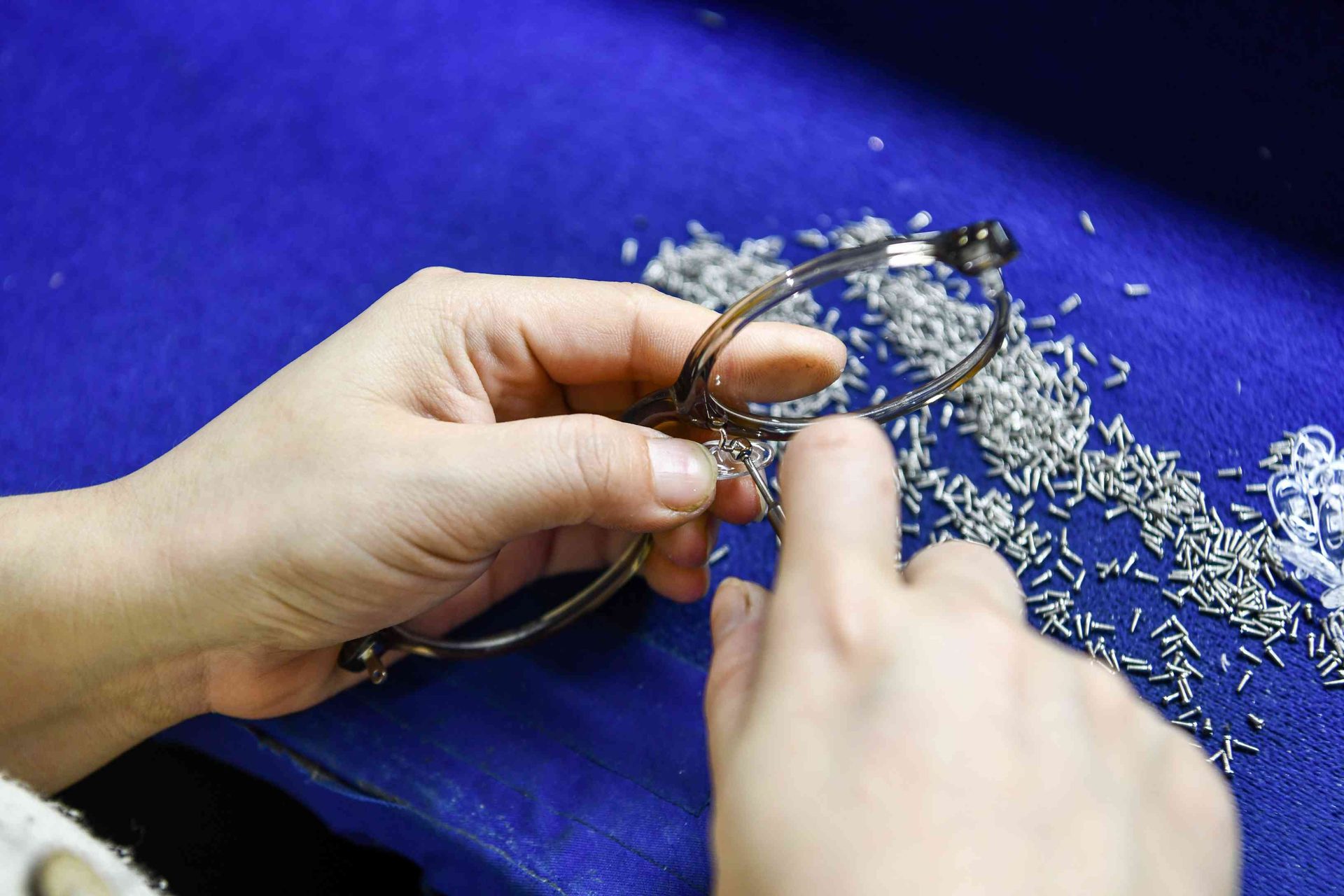
The hinge is a small part with an outsized effect on how eyewear feels, lasts and gets repaired. For a buyer, choosing a hinge is not simply a choice between “standard” and “premium”: it affects frame architecture, sampling, unit cost, quality control and after-sales service.
Quick answer: choose a 3- or 5-barrel hinge for dependable, repairable everyday eyewear; a spring hinge for extra flex and comfort; or a screwless/hidden hinge when design distinction justifies higher cost and a more specialized repair route.
The four main eyewear hinge types
| Hinge type | Main advantage | Trade-off | Best suited to |
|---|---|---|---|
| Barrel hinge | Proven, economical and repairable | Screw can loosen if poorly fitted | Most optical frames and sunglasses |
| Spring hinge | Temples flex outward for comfort | More parts, cost and fatigue variables | Reading glasses, broad-fit and kids’ styles |
| Screwless hinge | Clean design with no conventional screw | Supplier-specific parts; repair may be harder | Lightweight and design-led collections |
| Hidden hinge | Minimal exterior hardware | Tighter construction tolerances and higher cost | Premium acetate and fashion frames |
Barrel hinges: the dependable default
A barrel hinge uses alternating metal loops joined by a screw or pin. Three-barrel hinges are compact and common; five-barrel versions provide more bearing area and can feel more substantial. A higher barrel count does not automatically mean better quality. Precise alignment, suitable metal, secure attachment and the correct screw fit matter more.
Barrel hinges are easy for opticians to adjust or repair with standard parts. That makes them a strong default for private-label collections where predictable cost and global serviceability matter.
Spring hinges: comfort with more engineering
A spring hinge allows the temple to move slightly beyond its normal open position and return. This can improve comfort across different head widths and reduce stress from users putting glasses on with one hand.
The trade-off is complexity. The internal spring, housing and stop introduce additional failure points. Buyers should evaluate return action, left-right symmetry and fatigue performance rather than judging only the first sample’s feel. Spring hinges can be useful for reading glasses and children’s collections, but they do not replace correct frame sizing.
Screwless and hidden hinges
Screwless systems use interlocking, flexing or pinned constructions instead of a conventional removable screw. They can reduce screw-loosening complaints and create a distinctive lightweight look. However, proprietary parts can make field repair less straightforward.
Hidden hinges place most hardware inside the temple or frame front. They suit clean, premium designs—especially acetate—but require accurate pockets, secure embedding and careful polishing. Discuss the hinge before finalizing your eyewear tech pack, because it may change temple thickness and tooling.
How to choose the right hinge
Use these five questions:
- Who will wear the frame? Kids, reading-glasses users and broad-fit customers may value controlled flex.
- What is the frame material? Acetate, injection plastic and metal frames use different attachment methods.
- What is the target retail price? Spend on a feature customers can feel, not a hidden specification with no user benefit.
- How will repairs work? Standardized screws and parts simplify global after-sales support.
- What does the design require? Minimal temples may need a hidden or screwless construction.
What to specify and test
Record the hinge supplier/model, dimensions, material or finish, attachment method and screw specification in the tech pack. During sampling, check:
- smooth, even opening force on both temples;
- temple alignment when open and folded;
- side play, gaps, sharp edges and pinch points;
- screw retention or spring return after repeated cycling;
- plating, welding, embedding and surrounding surface finish.
There is no universal cycle number for every frame and market. Set a test method and acceptance threshold appropriate to the product, then keep the approved golden sample as the tactile and visual reference. Product claims and compliance should be confirmed for the destination market.
Build the hinge into the design—not the final quotation
Selecting hardware early prevents late changes to temple thickness, tooling and cost. Send HAO Eyewear your concept, target user and price tier, and we can recommend a serviceable hinge construction for sampling. Discuss your frame project and receive a feasibility response within 24 hours.