Acetate is the only frame material that gets called “beautiful” by people who don’t care about eyewear. Walk into any independent optical boutique — the frames the owner points to first, the ones displayed under a spotlight, the ones that justify a $300+ price tag — are almost always acetate. Not because acetate is the most practical material (it isn’t — TR90 is lighter, titanium is stronger), but because it has something the others don’t: depth. The color runs through the material, not on top of it. The surface has a warmth that metal and injection plastic can’t replicate. And the hand-finishing means no two frames are exactly identical.
For B2B buyers, understanding acetate manufacturing is the key to competing in the premium segment. This guide covers the full production process, the material grades, the cost structure, and how to evaluate an acetate frame factory.
Key takeaways
- Acetate frames are made from cellulose acetate sheets, cut by CNC and finished by hand in 20-50 process steps. This is fundamentally different from injection-molded frames (TR90, polycarbonate) and explains the cost premium.
- Italian Mazzucchelli acetate is the gold standard — it adds 20-40% to raw material cost but provides superior color depth, exclusive patterns, and a brand story that sells.
- Hand-polishing is the defining quality step — the difference between a $3 frame and a $15 frame is not the material; it’s the hours of hand-finishing on the polishing wheel.
- MOQ is ~500 pieces per style for custom acetate production; lead time is 30-40 days, with sampling at 10-21 days.
- China’s Danyang region sources genuine Italian Mazzucchelli and has the skilled hand-polishing labor force that acetate manufacturing requires.
What is cellulose acetate?
Cellulose acetate is a plant-based thermoplastic — made from cotton linters or wood pulp, not petroleum. It was introduced to eyewear in the late 1940s as a replacement for cellulose nitrate, a flammable material that occasionally caused injuries when frames were exposed to heat or flame. The switch to acetate made eyewear safer, and the material’s unique aesthetic properties — the ability to hold deep, embedded colors and patterns — made it the default choice for premium frames.
Key material properties relevant to B2B buyers:
| Property | Acetate | TR90 (for comparison) |
|---|---|---|
| Raw material | Cotton linters / wood pulp (renewable) | Petroleum-based thermoplastic |
| Color integration | Embedded through full thickness | Surface color (painted or molded-in) |
| Weight (typical frame) | 22-35 g | 18-22 g |
| Hand-feel | Warm, substantial, tactile | Light, slightly warm |
| Adjustability | Heat-adjustable by optician | Heat-adjustable (less range) |
| Finish types | Polish, matte, crystal, lamination, carved | Polish, matte, texture |
| Hypoallergenic | Yes | Yes |
| Manufacturing method | CNC cutting + hand finishing | Injection molding |
| Process steps per frame | 20-50 | 5-10 |
| Relative raw material cost | $$$ | $ |
Mazzucchelli vs standard acetate: the quality tiers
Not all acetate is equal. The grade of acetate sheet used is the single biggest determinant of a finished frame’s look and feel. There are three tiers:
Tier 1: Italian Mazzucchelli acetate
Mazzucchelli 1849, based in Castiglione Olona, Italy, has been producing cellulose acetate since — as the name suggests — the mid-19th century. Their acetate sheets are the industry benchmark. What makes Mazzucchelli different:
- Color depth and clarity — Mazzucchelli acetate has a translucency and color saturation that lower-grade acetate does not replicate. The tortoiseshell and havana patterns are especially distinctive, with fine, organic-looking color variation.
- Exclusive colorways — Mazzucchelli produces seasonal color collections, including limited-run patterned blocks that are not available from other suppliers. Brands use these exclusives to differentiate their collections.
- Consistent density — Mazzucchelli sheets have tight density tolerances, which matters because inconsistent density causes CNC tool chatter and uneven polishing. A frame made from consistent acetate machines more cleanly and polishes more evenly.
- Brand cachet — “Made with Italian Mazzucchelli acetate” is a meaningful line on a product page. Consumers who know eyewear recognize the name. For brands positioning at $200+ retail, it is nearly table stakes.
Mazzucchelli acetate typically adds 20-40% to the raw material cost per frame. For a premium collection, it is worth it. For a value-tier collection, standard acetate or TR90 is the better fit.
Tier 2: Standard Italian / Japanese acetate
Several manufacturers in Italy and Japan produce high-quality acetate sheets that are functionally similar to Mazzucchelli at a slightly lower cost. The color range is narrower and the brand story is less developed, but the material quality is excellent. This tier is the practical choice for mid-market brands that want the acetate look and feel without the Mazzucchelli price premium.
Tier 3: Chinese / generic acetate
Chinese acetate sheet production has improved significantly in the last decade. The best Chinese acetate now approaches the quality of standard Italian sheets at a meaningfully lower cost — roughly 30-50% less than Mazzucchelli. The trade-off: fewer exclusive colorways, slightly wider density tolerances (which can affect CNC milling quality), and no brand story for the end consumer. For brands positioning under $100 retail, Chinese acetate is a viable and increasingly common choice.
Our factory stocks all three tiers and can source specific Mazzucchelli color codes for custom orders. Tell us your price point and positioning, and we match the material grade accordingly.
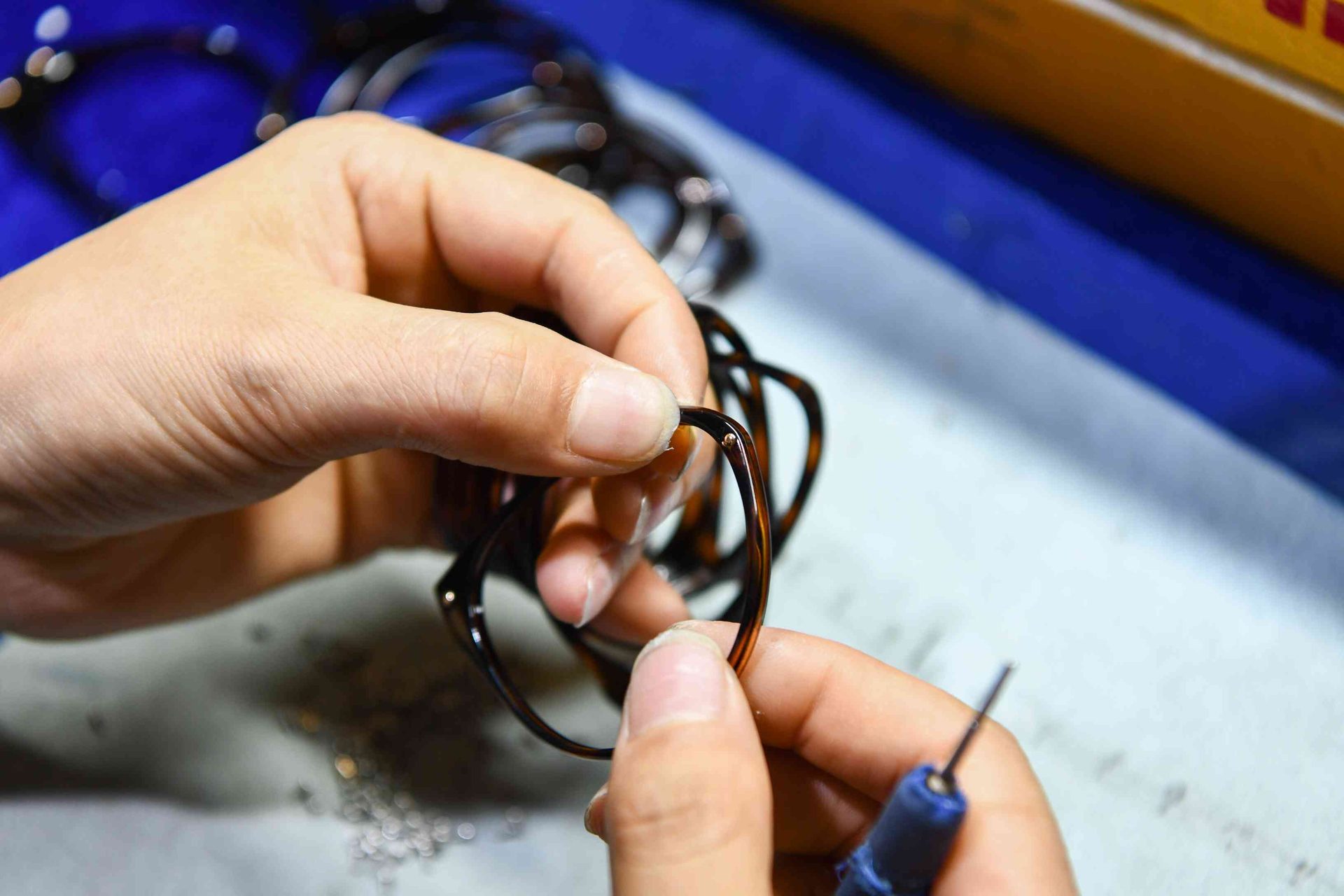 Acetate frame assembly is done by hand. The screws are micro-size, the hinges require precise alignment, and the acetate surface must be protected from scratches throughout.
How an acetate frame is made: the full production sequence
Acetate frame production is fundamentally different from injection molding. There is no mold, no rapid cycle time, no near-net-shape output. Every frame starts as a flat sheet and is cut, shaped, polished, and assembled in a process that resembles sculpture more than mass production. Here is the full sequence:
Stage 1: Sheet selection and blocking
The process begins with acetate sheets — typically 4-8mm thick for frame fronts, 4-6mm for temples. The sheet is inspected for color consistency and surface quality. For patterned acetates (tortoiseshell, havana, laminated stripes), the pattern orientation is considered — how the pattern will flow across the frame front and down the temples. The sheet is cut into rough blocks sized for individual frames.
Stage 2: CNC cutting and shaping
This is where the frame geometry emerges. A CNC milling machine cuts the frame front and temples from the acetate block. Unlike metal machining — where the challenge is the material’s hardness — acetate machining is about precision at speed without overheating. Acetate softens at relatively low temperatures, so CNC cutting requires optimized feed rates, sharp tooling, and often cooling to prevent the material from gumming up the cutter or losing dimensional accuracy.
The CNC stage also cuts the lens groove, the hinge insertion slots, and any decorative cutouts or bevels. The quality of CNC programming and tooling determines how crisp the frame edges are and how much hand-finishing work will be needed later.
Stage 3: Tumbling (barrel polishing)
After CNC cutting, the frame components have a matte, slightly rough surface. They go into large rotating barrels — tumbling drums — filled with wood chips, polishing compound, and sometimes small ceramic or bamboo media. The frames tumble for 24-72 hours, depending on the desired finish level and the acetate grade. This step smooths the surface, rounds sharp edges, and begins to develop the luster that distinguishes acetate from injection plastic.
Tumbling is part science, part craft. The wood chip type (beech, walnut, bamboo), the polishing compound, the barrel rotation speed, and the duration all affect the result. A factory that knows its tumbling parameters produces frames that need less hand correction. A factory that rushes the tumble produces frames with micro-scratches that hand-polishing cannot fully remove.
Stage 4: Hand polishing
This is the defining stage — and the one that separates commodity acetate frames from premium ones. A skilled worker holds the frame against a rotating cotton or sisal wheel charged with progressively finer polishing compounds, working each surface — front, back, bridge, endpieces, temple interiors, temple exteriors — until the acetate achieves a smooth, lustrous finish.
Hand polishing an acetate frame takes 10-30 minutes per frame, depending on the design complexity and the finish target. High-polish (mirror) finishes take longest. Matte finishes require a slightly different technique — the surface is textured with fine abrasive, then sealed. The worker’s skill determines the evenness of the finish, the consistency between the left and right temples, and the clean treatment of tight corners and inside curves.
This is why acetate frame costs are driven so heavily by labor. You can CNC-cut 1,000 frame fronts in a day. You cannot hand-polish 1,000 frame fronts in a day — not to a premium standard. The number of skilled polishers a factory employs is a direct indicator of its acetate production capacity.
Stage 5: Hinge insertion and assembly
Acetate frames use one of two hinge attachment methods:
- Heat insertion — the hinge is heated and pressed into a pre-cut slot in the acetate. The acetate softens, conforms to the hinge tangs, and locks them in place as it cools. This is the traditional method and is preferred for premium frames because it creates a clean, seamless joint.
- Ultrasonic insertion — ultrasonic vibration generates localized heat to seat the hinge. Faster than heat insertion and more consistent for high-volume production; still produces a clean joint when done correctly.
After hinge insertion, the temples are mounted, and the frame undergoes dimensional checking — temple-to-temple alignment, temple opening angle, lens groove consistency, bridge symmetry.
Stage 6: Final inspection and quality control
Each frame is hand-inspected under magnification. The QC checklist covers: surface finish (no scratches, dull spots, flow marks, or polish residue), color consistency (front-to-temple match), hinge fit (flush, no gaps, smooth open/close), temple tension (even on both sides, firm snap-close), endpiece seams (clean, no gaps), lens groove integrity (uniform depth, no chips), and overall fit and finish.
A frame that fails any of these checks goes back for rework or is scrapped. The QC pass rate for premium acetate is typically 85-95% — lower than injection frames (95%+) because the hand-finishing introduces more variables.
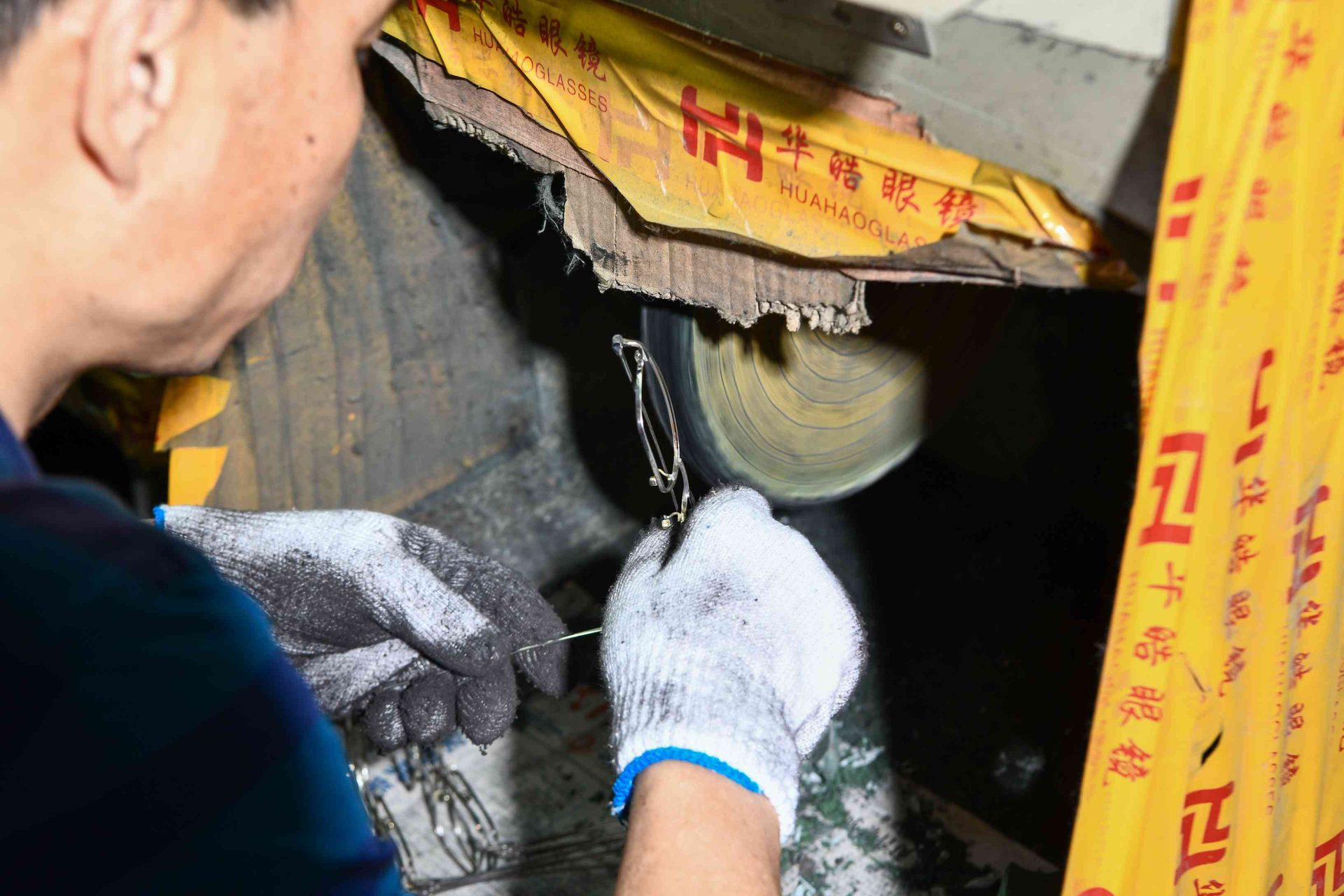 Hand-polishing on a rotating wheel: the worker applies progressively finer compounds to achieve the acetate’s final luster. This skill takes months to learn and years to master.
Acetate cost structure: where the money goes
Understanding acetate’s cost drivers helps you read quotes and identify where savings are (and aren’t) possible.
| Cost driver | % of total cost (approx.) | What affects it |
|---|---|---|
| Raw material (acetate sheet) | 15-25% | Mazzucchelli vs standard, sheet thickness, pattern complexity |
| CNC machining | 10-15% | Design complexity, number of cut paths, tooling amortization |
| Tumbling | 5-10% | Duration, media type, finish target |
| Hand polishing | 25-40% | Finish type (mirror vs matte), design complexity, labor skill level |
| Hinges and hardware | 5-10% | Standard barrel vs spring hinge, branded vs generic |
| Assembly and QC | 10-15% | Hinge insertion method, QC standard, rework rate |
| Packaging | 5-10% | Standard vs custom branded case/box |
The key insight: material cost is not the dominant driver — labor is. A frame made from Mazzucchelli acetate and a frame made from standard acetate may differ in raw material cost by $2-4, but the polishing, assembly, and QC labor costs are nearly identical. This is why premium acetate commands its price: the labor investment is the same regardless of material grade, so using a better material is a relatively small increment for a significantly better product.
MOQ, pricing, and lead times
MOQ
| Order type | MOQ | Notes |
|---|---|---|
| Custom OEM acetate (new design) | 500 pcs/style | Covers CNC programming, tooling setup |
| Custom OEM (existing design file, new color) | 300-500 pcs/style | Lower if the CNC program exists |
| Mazzucchelli-specific color order | 500+ pcs/style | Some exclusive colors have higher MOQ from the sheet supplier |
| Custom ODM (factory design, your brand) | 300-500 pcs/style | Faster — design files already exist |
| Ready stock acetate | 1 pc/style | Available in standard and premium acetate |
Pricing (indicative FOB, custom OEM)
| Acetate grade | Price per frame at MOQ (500 pcs) |
|---|---|
| Standard Chinese acetate | $3.00-6.00 |
| Standard Italian acetate | $5.00-9.00 |
| Mazzucchelli acetate | $7.00-15.00 |
| Mazzucchelli + premium finish + spring hinge | $12.00-20.00 |
Prices vary by design complexity, finish type, hinge specification, and order volume. These are factory cost ranges — retail pricing typically runs at 3-5× factory cost depending on brand positioning and distribution channel.
Lead times
| Stage | Timeline |
|---|---|
| Design & quotation | 2-5 working days |
| Sampling | 10-21 working days (longer for complex laminations or exclusive Mazzucchelli colors) |
| Bulk production | 30-40 working days |
| Ready stock fulfillment | ~7 working days |
Acetate production lead times are 5-10 days longer than TR90 because of the hand-finishing bottleneck. There is no shortcut around it — a factory that quotes significantly shorter lead times for acetate is either cutting corners on finishing or not actually manufacturing in-house.
Sourcing acetate frames from China
China is the world’s largest acetate eyewear producer, and the center of gravity is Danyang, Jiangsu — the eyewear capital where material suppliers, CNC workshops, and skilled polishers are co-located within a few kilometers. Several factors make Danyang uniquely suited to acetate production:
- Direct Mazzucchelli access — Danyang factories source genuine Italian Mazzucchelli sheets through established import channels, passing the savings (lower freight consolidation, local warehousing, no middleman markup) to the buyer.
- Polishing labor force — hand-polishing acetate is a skill that takes months to learn and years to master. Danyang has a multi-generational workforce of polishers, built up over 40+ years of eyewear manufacturing.
- CNC density — local CNC programming talent means fast design-to-cut turnaround and lower amortization cost per frame.
- Integrated production — the best acetate factories in Danyang combine sheet selection, CNC cutting, tumbling, polishing, hinge insertion, assembly, and QC under one roof, which eliminates the quality gaps that occur when frames move between separate workshops.
When evaluating an acetate factory, ask for:
- A polishing sample vs a production piece — the sample shows what they can do when they try; the production piece shows what you will actually receive. Compare them side by side.
- Mazzucchelli authenticity — genuine Mazzucchelli sheets come with batch documentation. Ask to see it.
- A factory visit video — focus on the polishing section. Count the number of polishing wheels. A factory with 20+ wheels running daily is producing at scale. A factory with 3-5 wheels is a small workshop and may not handle your volume.
For more on material comparisons, see our TR90 vs Acetate vs Titanium guide. For the other premium frame material, see our titanium eyewear manufacturing guide. And for the economics of custom production, see our eyewear cost breakdown.
Is acetate right for your brand?
Acetate is the right material if your brand positioning is fashion-forward, design-driven, or premium. It is the wrong material if you are competing on price in the value segment — TR90 does that better. But if your customer cares about how a frame looks and feels, acetate is the material that delivers the highest perceived value per gram of anything in the optical cabinet.
The brands that build their identity around acetate do not apologize for the price — they explain it. They talk about the 50 hands that touched the frame. They name the Italian mill that made the sheet. They let the customer see the tortoiseshell pattern close-up. That is not marketing fluff — it is the actual production story that acetate makes possible. No other frame material gives you that much to talk about.
Sourcing acetate frames for your brand? Tell us your material preference (Mazzucchelli, Italian, or standard), color direction, volume, and target price point. We respond within 24 hours with a tailored proposal, including material samples, pricing, and lead time. Request a quote or browse our ready-stock acetate selection.